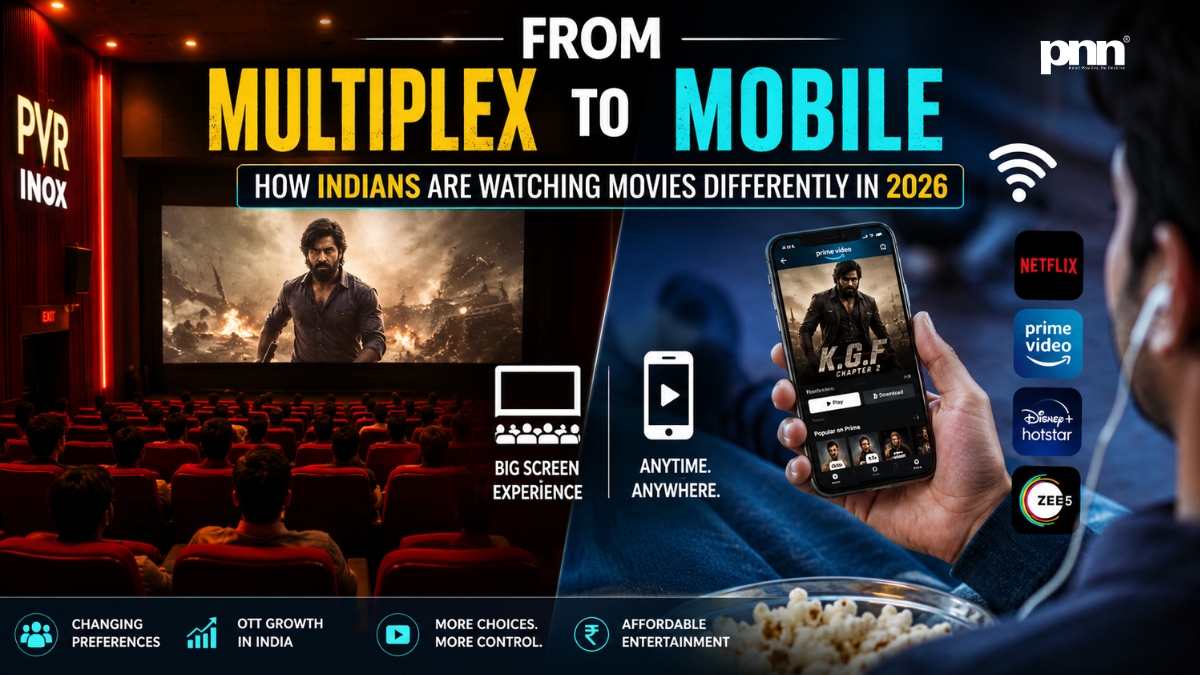
Mumbai (Maharashtra) [India], July 23: Remember that hush in the theatre just before a movie started? The lights dimmed, people stashed their phones, popcorn passed from lap to lap, and for the next couple of hours, everyone disappeared into the film together. That feeling is still around if you step into a PVR INOX in 2026—but now, it’s not the only way. The same folks who flocked to see Pathaan on opening day are just as likely to watch half of this week’s release on a five-inch phone, curled up in bed, subtitles on, volume so low it won’t wake anyone up.
This change didn’t show up all at once. Indians didn’t suddenly stop loving movies. What happened was, money, tech, and the way daily life works here all shifted, almost quietly, until one day the new normal just… was.
The math changed first
Take a family of four to a multiplex these days and you’re looking at about ₹280 a ticket. Add popcorn and a drink per person—another ₹150 each—and that’s close to ₹2,000 just for one outing. Or you could sign up for a year of JioHotstar or Prime Video for ₹999 to ₹1,499. That’s less than one family night out. So it’s not about loyalty to movie theatres. It’s about numbers. No wonder mid-budget Hindi and regional films hit streaming platforms barely a month after they show up in theatres. People have clocked this, and honestly, most of them just wait.
5G did the rest
Ask anyone in a smaller city how things changed and usually the story begins with a SIM card. Dirt-cheap 5G data—still around ₹4 per gig—plus 400 million 5G users across India means you can stream a movie anytime, anywhere, no buffering, no hassle. So it’s not just Mumbai or Bengaluru riding the subway while watching Jawan on their screens. Now it’s someone in Kanpur or Coimbatore, same picture quality, not even thinking about network speed. Watching movies on a phone isn’t a “big city thing” anymore. It’s just what everyone does.
The quiet but powerful merger
Most people barely blinked when Reliance and Disney fused their streaming services into one giant platform. But suddenly almost everything was there—cricket, Bollywood, Hollywood, tons of regional language titles—all under one roof, one payment, one login for the whole house. Why mess with five or six different apps? That kind of simplicity is the sort of nudge in people’s habits that ten ad campaigns could never pull off.
Theatres aren’t dying, they’re just getting pickier
People love saying “OTT killed the cinema,” but the picture’s more complicated. Multiplexes aren’t empty. They’re just more careful about what they show. A mega-movie like KGF: Chapter 2, RRR, or Kantara? Still packs the house. These loud, massive spectacles need the big screen—and families still show up, especially if there’s a superstar or a hit soundtrack everyone’s humming before release day. What vanished is the quiet, drama-heavy movie playing to half-full seats on a random Tuesday. Those films don’t get three weeks in cinemas anymore—they get a few days, then head straight for mobile.
Watching together, but differently
Movie night with the family? It’s not gone, it’s just moved. Instead of piling into the car and fighting traffic for a night out, people huddle around a Smart TV in the living room, streaming the latest release. With fibre broadband reaching smaller towns, even semi-urban families find their own version of the movie outing—minus the drive, the parking hassle, and the long line at the counter.
Gen Z rewrote the rules
Young people split their attention in ways that would blow your mind. A trailer lands on Instagram Reels, gets chopped up, memed, and spread in hours. By the time the actual movie drops, some 19-year-old in Delhi has already decided: Big screen event or save it for streaming later? Usually, all based on a ten-second video. About a third of multiplex crowds now are Gen Z—and they come for the action, the spectacle, the stuff that feels big. The rest? Waits on their phones, ready for when there’s a free moment.
So, what does 2026 look like?
Honestly, it looks like both worlds running side by side. The multiplex is the special-occasion place—the one you go to for the truly huge films, the ones that just seem wrong on a phone. For everything else—mid-budget movies, offbeat regional stuff, films with smaller releases—the phone is king. Those movies might get missed in theatres, but find a new life weeks later on someone’s lunch break or the way home from work. Indian audiences haven’t ditched movie theatres. They’ve just stopped treating them as the only option.
Every night, the lights still fade at PVR INOX, some magic still happens. But now, half the crowd who missed the show are seeing the same movie an hour later, headphones in, on a bus, screen resting in their hand.